
How to Search Criminal Dockets
Start with the Nebraska Judicial Branch case information page. It points to JUSTICE Trial Court Case Search as the statewide route for public trial-court cases. A case number is the cleanest key. With a name-only search, add the court, county, case type, and year. A common name can pull in unrelated matters. Red Willow County criminal dockets may sit in County Court or District Court. Pick the right court before trusting a match.
For a quick first pass, use the one-time JUSTICE name search. The subscriber service adds filters that reward repeated searching. A courthouse public terminal and the clerk fill the gaps when an online result is incomplete, older, or restricted. When you request a copy, name the court, Red Willow County, the case number, the document, and the date. Want a typed transcript? That comes from the court reporter, not the ROA.
- Start with the case number if it is available; otherwise use the public name-search route.
- Confirm Red Willow County, the court, case type, year, and caption before opening a result.
- Read the public ROA for event dates, hearing entries, orders, disposition language, costs, and available images.
- Use the free court calendar and the appropriate clerk for a current hearing.
- Request a certified order or other file copy from the clerk when the exact document is needed.
Note: An empty online result can mean several things. The court choice may be wrong, the entry may be delayed or restricted, or the case may predate the electronic conversion period.
Red Willow Criminal Docket Search Fields
JUSTICE works best with narrow search keys. The one-time public route runs on a party name and allows limited result access. Subscriber search adds court type, case type and subtype, county, year, judge, attorney, judgment date, and case number. For a Red Willow County criminal docket, always set the County Court or District Court layer first. Then call a result a match.
| Search field | How it helps with a Red Willow criminal docket |
|---|---|
| County | Limits the search to Red Willow County rather than statewide namesakes. |
| Court type | Separates County Court proceedings from District Court trial-stage felony records. |
| Case type and year | Helps distinguish criminal, traffic, and older matters with similar captions. |
| Case number | Provides the strongest link to the correct ROA and clerk file. |
The JUSTICE one-time search entry posts the public agreement that governs the search before you begin. It is a locator. Treat it as a lead, then verify the details with the court.
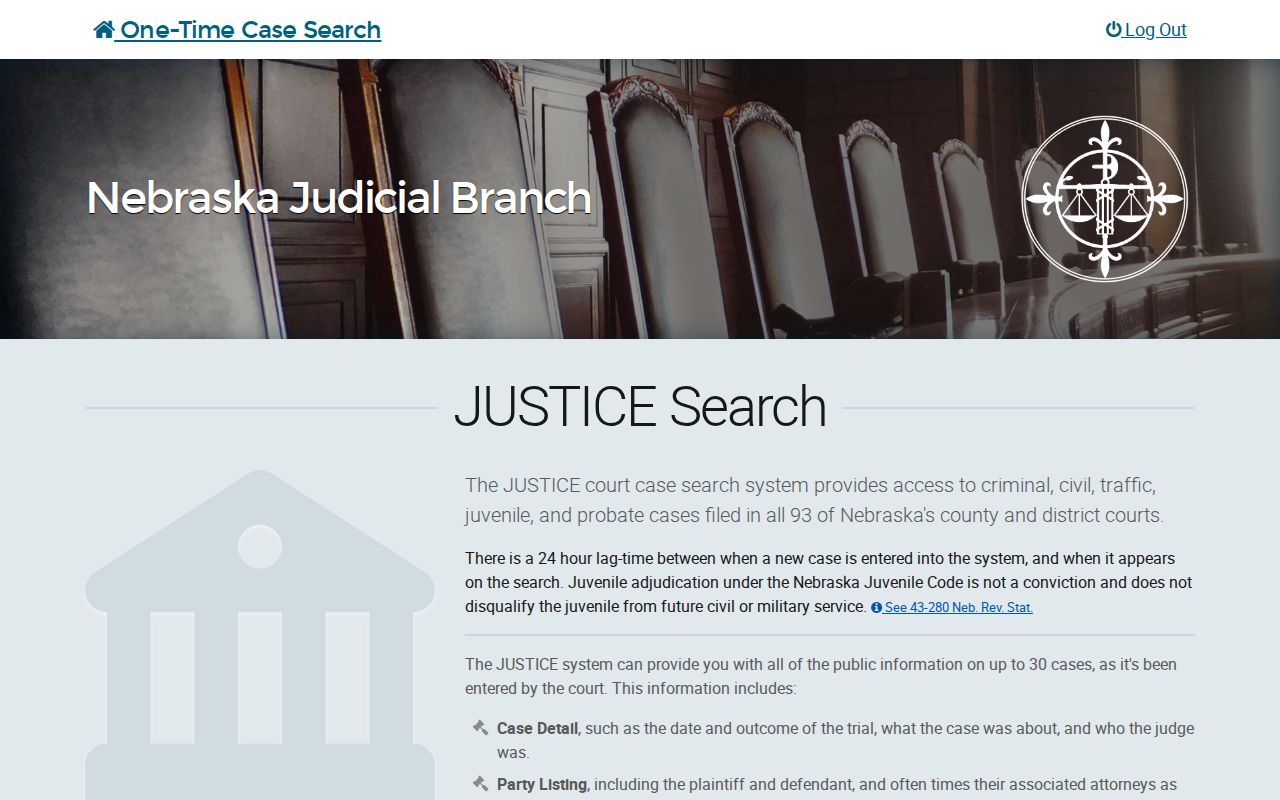
After a name-based result, confirm the court and the case number before trusting the entry the screen shows.
What a Criminal Docket Shows
A Red Willow County criminal docket works as a timeline, not a story. Each entry lists the court, the case number, public party roles, and public offense information. You may also see hearing dates, orders, financial entries, and document images. That depends on what the clerk has. What you will not get is a full account of the allegation. Nor will you get a transcript of what anyone said. Keep in mind that an image can be missing. The event itself still shows up in the Red Willow County record.
| Case identity | Court, Red Willow County, year, type, and case number, such as CR or another public case-type clue. |
|---|---|
| Charge entry | Public offense description or charge information as displayed. A charge is not a disposition. |
| Events | Filing, arraignment, hearing, continuance, order, plea, and disposition dates in sequence. |
| Judicial record | Assigned court or judge and public order or judgment information when available. |
| Financial entries | Costs and payments shown in the public case information, not a complete financial statement. |
| Access status | Available public image, restricted item, or sealed-record boundary where applicable. |
Think of a Red Willow County criminal ROA as a chronological index of the case. Depending on what is public, it can list the court, the case number, party roles, offense information, hearing dates, orders, financial entries, and document images. It is not a narrative of the allegation. It is not a transcript either. An event can appear in the ROA while its document image stays absent.
Red Willow Criminal ROA Codes
Case-type codes are clues, not conclusions. Nebraska case-type labels include CR, TR, CI, PR, JV, and SC. In a Red Willow County criminal search, CR points toward a criminal matter. TR commonly signals traffic. Court and year still matter. Related proceedings can move between dockets or carry different numbers.
- ROA
- Register of Actions, the dated list of filings, events, hearings, orders, and dispositions.
- Arraignment
- A court setting at which the charge and plea process are addressed; it is not a final outcome.
- Continuance
- A hearing moved to another time. Confirm the new setting with the calendar or clerk.
- Disposition
- The recorded resolution of a charge or case. Its exact wording controls.
Financial entries can show up too. They do not settle a final balance, fix a legal outcome, or explain what every filing means. When the public ROA leaves doubt, the clerk can point you to the right case file or a certified order.
Stages on a Criminal Docket
A Red Willow County criminal case usually moves through recorded stages. The ROA may begin with a filing. It may then list an arraignment, later settings, motions, a plea or trial event, orders, disposition, and sentencing information where public. Dates can shift. A calendar setting is only a scheduled event, not a result.
Docket flow: Filing → Arraignment → Pretrial → Plea or Trial → Disposition → Sentencing
Treat the official calendar as a lead and verify with the court. The docket can explain why a setting moved. For a same-day change or a modified-operations notice, the clerk is the one to confirm it.
No-Result Red Willow Criminal Searches
A no-result search does not prove a Red Willow County criminal case never existed. New matters can lag the index by roughly 24 hours. Red Willow criminal and traffic coverage in the system began in June 1998. Older cases may need a retention or paper-file inquiry. A wrong county, court type, spelling, case year, or restriction can also block a match.
The JUSTICE installation-date table is the source for that 1998 Red Willow boundary. Retry a temporary portal error. Search again with precise court and case details. Then contact the clerk. An empty modern index is never a historical conclusion.
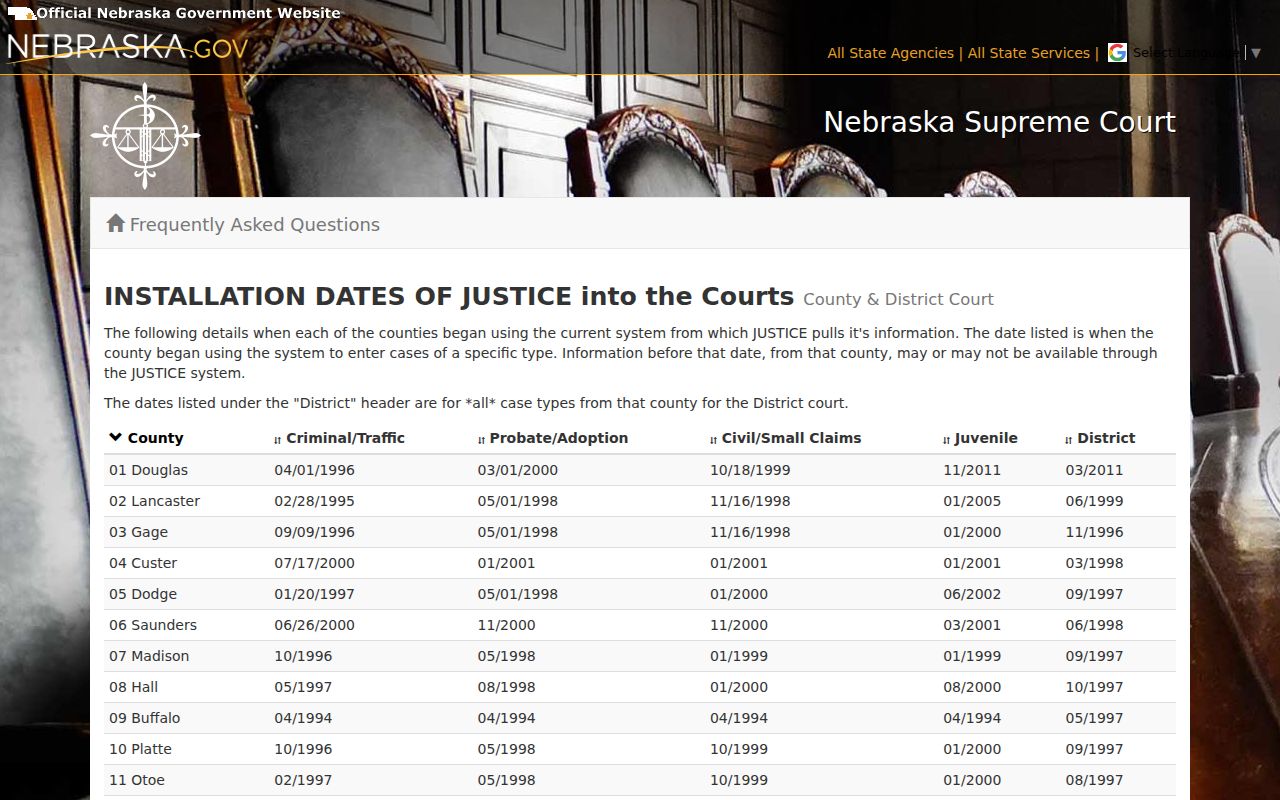
That table gives useful context. It shows when a criminal record predates the online system, not that no paper record remains.
Which Court Holds Criminal Dockets
Criminal work in Red Willow County splits between two courts. County Court handles misdemeanors, traffic cases, and city and village ordinance matters. It also holds preliminary hearings in felony cases. Gretchen Wiebe is the County Court Clerk Magistrate. She keeps that court's docket and the routes for getting copies. District Court takes over once a felony reaches the trial stage. Lori O'Dea, the District Court Clerk, holds those criminal records and judgments.
The Red Willow County Court office lays out County Court jurisdiction. The District Court clerk office shows the path to District Court records. Both courts sit in McCook. They are not interchangeable. Before you search, check which court the notice or case number names. A docket search aimed at the wrong clerk will miss the case you want.
Red Willow Felony Docket Handoff
A felony can start in one Red Willow County courtroom and finish in another. It may appear first in a County Court preliminary proceeding, then surface later as a District Court trial-stage case. That handoff explains a common surprise. A docket search limited to one court can miss public events from the same matter. Confirm the court and the case number first. Then check the filing posture and the date before treating two results as one case.
County Court criminal records
Gretchen Wiebe, Clerk Magistrate/County Court Clerk
502 Norris Avenue, McCook, NE 69001
308-345-1904
District Court criminal records
Lori O’Dea, District Court Clerk
502 Norris Avenue, McCook, NE 69001
308-345-4583 ext. 6
Bring a preliminary, misdemeanor, traffic, or ordinance docket question to the County Court clerk. The District Court clerk handles felony trial-stage files, District Court judgments, and District Court calendar checks.
Public Access and Sealed Criminal Dockets
Nebraska opens several categories of court information to the public. You can generally see the party index, a case summary, the ROA, calendar information, judgment summaries, and document images where they exist. The access has limits, though. Juvenile, adoption, sealed, and other restricted material does not behave like an ordinary public criminal docket. One more point matters. A public charge is not a finding of guilt. The Nebraska notice states that a juvenile adjudication is not a conviction.
Public-access rules: Nebraska Public Records Act §84-712 provides a general inspection and copy right during ordinary office hours, subject to exceptions and fees. Nebraska Supreme Court Rule §1-805 identifies searchable court-information categories. Article 8 does not turn a sealed or otherwise restricted file into a public record.
Need a plain public copy? File Form CC 3:29 with the clerk of the court that holds the file. Electronic access does not count as a certified copy. For a transcript, make a separate request to the court reporter.
Red Willow Sealed Criminal Records
Sealing is not a public-search workaround. The official adult-record-sealing material explains that you file the request in the court where the case was heard. It moves through an eligibility, notice, and order process. Once a judge seals an adult event, it drops out of ordinary public access. The court may also need time to update its systems after the order issues.
The adult record-sealing information describes the process and its limits. An eligible subject who wants a copy of a sealed file follows a separate route through the court holding the case. Juvenile and adoption records carry their own restrictions. Take those questions to the clerk rather than treating them as normal search results.
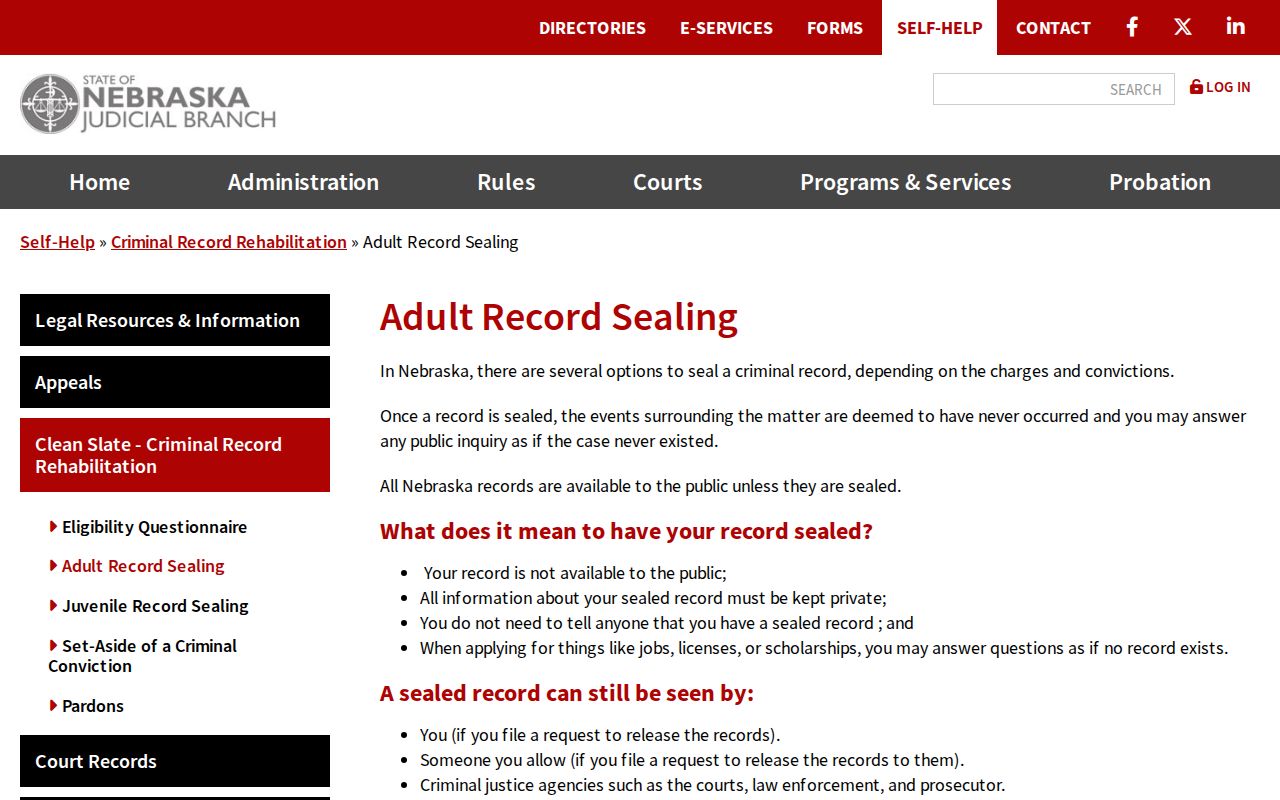
The sealing material draws a clear line between a court filing process and the public docket search used for ordinary records. Sealed-record copy instructions limit that route to an eligible subject or authorized requester, and they require contact with the court holding the file.
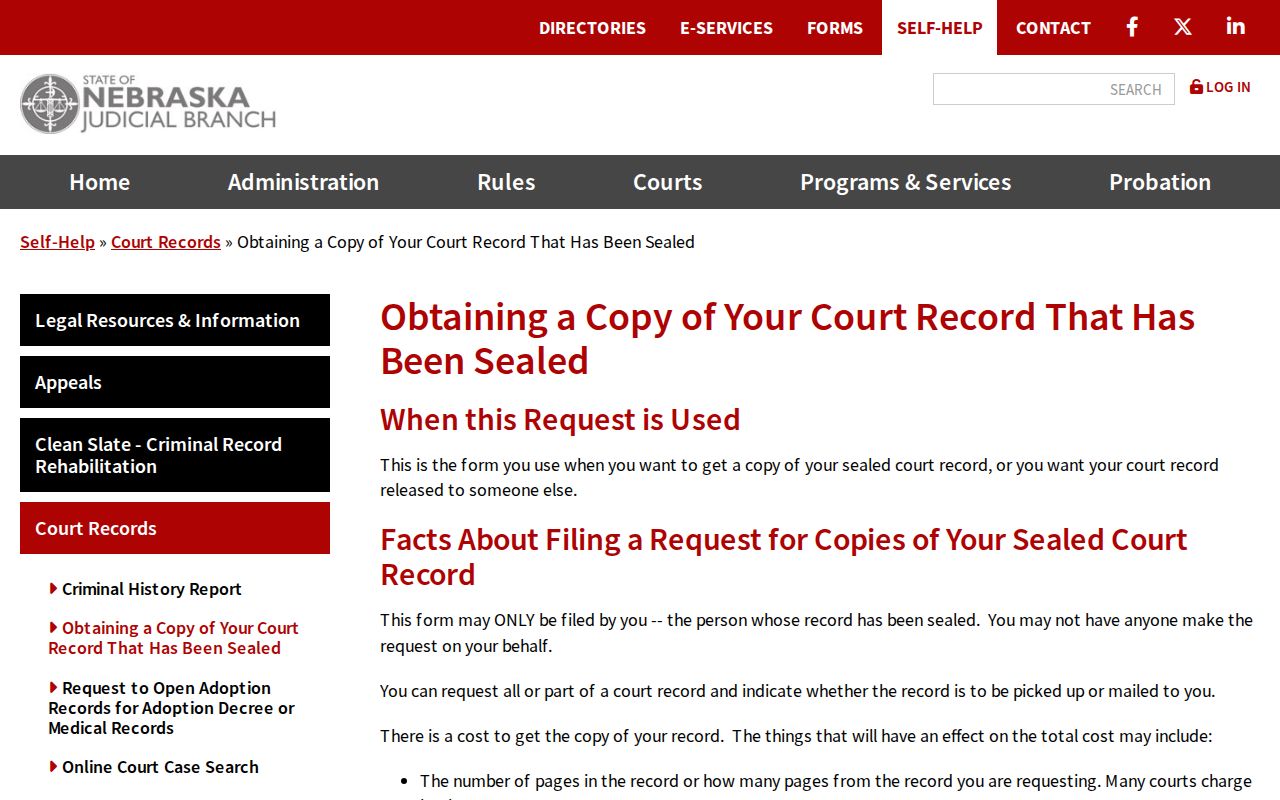
Those separate copy instructions reinforce the point: a sealed record takes a court-directed request, not a general public search.