
How to Search the McCook Court Docket
McCook does not offer a separate municipal-court lookup. Begin with the Nebraska Judicial Branch case-information service to get a public trial-court lead. For a routine McCook traffic, misdemeanor, or ordinance matter, pick or confirm County Court and Red Willow County. Felony trial-stage matters go to District Court instead. The same goes for larger civil and domestic cases, equity disputes, mental-health matters, and County Court appeals.
A McCook address alone won't tell you the jurisdiction. Keep the court, Red Willow County, case type, year, and case number in one place. The register of actions is what people usually call the docket, and it lists the hearings, filings, orders, and dispositions in order. Remember two limits. A public search lead is not a certified copy, and a calendar entry is not an outcome.
- Open the statewide JUSTICE trial-court search and identify the McCook matter by party name or case number.
- Confirm Red Willow County and choose County Court or District Court based on the case type.
- Read the McCook case summary and register of actions for the case number, status, and listed events.
- Use the free calendar for a McCook hearing lead, then verify a time-sensitive setting with the proper clerk.
- If the search is empty, ask the clerk about the court, year, restricted status, or an older paper record.
McCook Court Docket at the County Seat
McCook is a first-class city. Its 2020 Census population is 7,446, and it serves as the Red Willow County seat. That role matters for any McCook court docket search. Both working state trial courts sit in McCook rather than in a separate city courthouse. The Judicial Branch lists the court address as 502 Norris Avenue, McCook, Nebraska 69001.
County Court handles traffic and misdemeanors. It also takes city or village ordinance cases, preliminary felony hearings, small claims, probate, guardianship, adoption-access routing, juvenile matters, and copy requests. District Court takes the heavier work. Think felony trials, general civil, domestic relations, equity, mental-health cases, appeals, the judgment index, and District Court copies.
The McCook City Clerk source names the municipal office that runs city administration. That matters when your McCook question is about an ordinance rather than a court file.
That City Clerk material covers the administrative route only. It does not turn a city-office inquiry into a County Court docket search.
The McCook Municipal Court
McCook's official FAQ answers the big question plainly: the city has no municipal court. It sends court-fine questions to Red Willow County Court and lists 308-345-1906 for them. So skip any invented city court. Skip the city judge, the city case format, the city payment page, and any McCook municipal portal when hunting a McCook court docket. None of those exist.
For ordinance text and city administration, the McCook City Clerk is the right office. For a docket or a court fine, the Red Willow County Court Clerk Magistrate is the route. The same office handles public calendar leads and County Court copies. The clerk's official records phone is 308-345-1904. That number is separate from the city-office contact and from the FAQ's fine-question number.
The Judicial Branch biography for Judge Anne M. Paine shows the County Court judicial assignment. That assignment serves the McCook route.
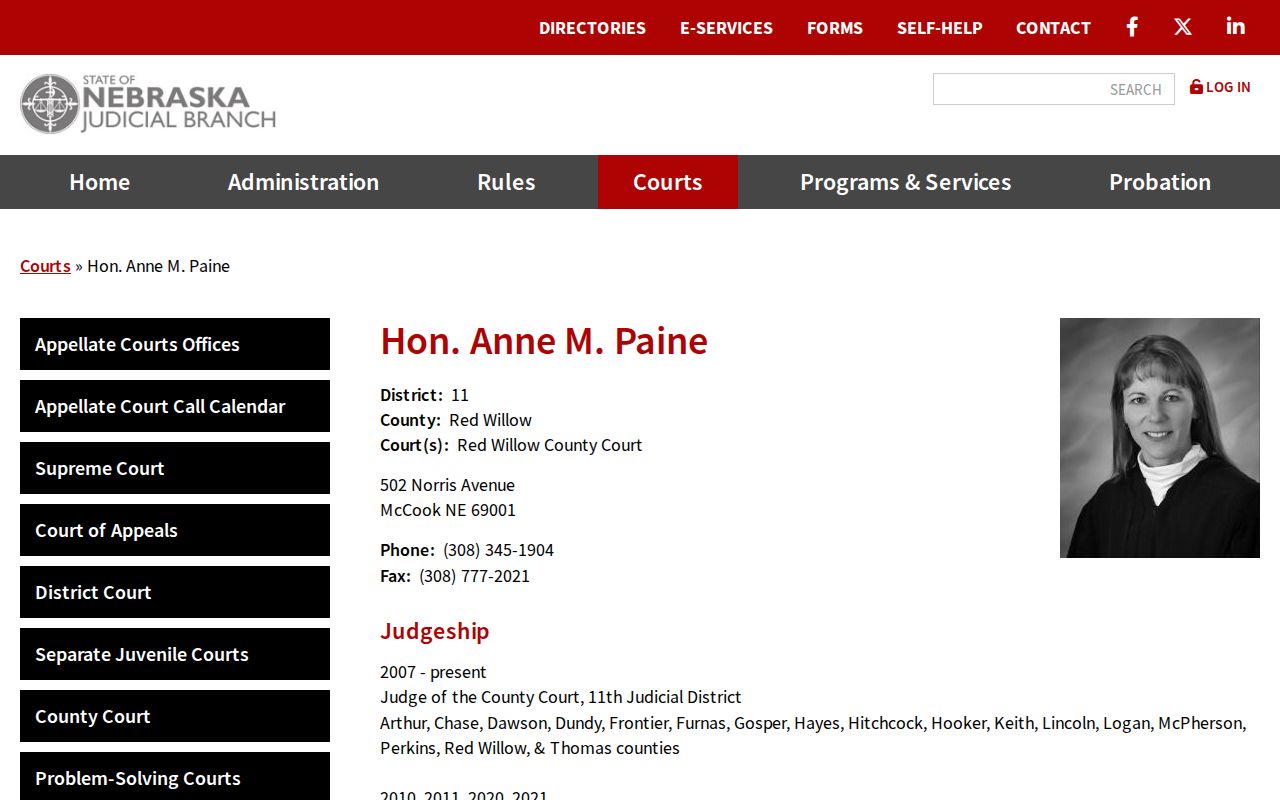
The judicial assignment tells you who presides over the County Court setting. The clerk stays the contact for any McCook record, calendar confirmation, or copy request.
McCook Court Docket and City Ordinance Text
A McCook court docket comes from one place. The text of a McCook ordinance comes from another. The city keeps its ordinances; the court keeps its case files. The city's own ordinances page warns that the online code may lag behind. It points readers to the printed code kept at city offices as the official version.
Keep those routes straight and you avoid a common trap. Locating a city rule proves nothing about a citation being filed. And a court docket entry proves nothing about which wording of the ordinance currently controls. Before you call either office, write two things down. Get the case number and the court name.
The McCook ordinances source carries that currency warning. It applies to the online code.
For McCook court docket work, the ordinance text explains the city rule. The register of actions records the court proceeding itself.
McCook Court Dates and Settings
Start with the free Nebraska court calendar when hunting a McCook hearing. Pick the right court type. Choose Red Willow County, then search by date or last name. A setting on that calendar is only a start. The register of actions fills gaps. It can explain a continuance, an order, or a disposition the calendar leaves unclear.
A McCook setting can shift. Treat the calendar as a lead rather than a promise. No result does not necessarily mean no court date; the calendar says so itself. County Court questions go to Gretchen Wiebe at 308-345-1904. District Court questions go to Lori O'Dea at 308-345-4583 ext. 6. Call before you drive over, since local and statewide directory hours are not fully aligned.
| Date | The scheduled McCook court event date, subject to a later continuation or reset. |
|---|---|
| Time | The listed time for the setting; confirm a same-day change with the court clerk. |
| Courtroom | The location shown by the calendar or case record at the McCook courthouse. |
| Judge | The judicial officer shown for the McCook County Court or District Court event. |
| Setting Type | The event label, such as arraignment, hearing, pretrial, trial, or compliance setting. |
McCook Court Docket: Two Clerks at 502 Norris
Two records desks share the McCook courthouse, not one. Gretchen Wiebe serves as Clerk Magistrate and County Court Clerk. Her office holds the County Court docket for traffic tickets, misdemeanors, ordinance cases, and preliminary-felony hearings, plus small claims, probate, guardianship, adoption, and juvenile files. Lori O'Dea is the District Court Clerk. That desk keeps District Court criminal, civil, and mental-health records, along with judgments, filings, service, and other proceeding papers.
Say which court holds the record you need. A McCook felony often starts in County Court with the preliminary hearing, while District Court keeps the trial file for the later felony case. Civil splits the same way. County Court handles civil claims up to $70,000 and small claims under $7,500. Anything larger, along with equity and domestic matters, goes to District Court. So ask for the specific court's records, not just a McCook court office. The Red Willow County comprehensive-plan source notes how county offices cluster at the courthouse.
Because both clerks sit at the same McCook address, a few details save real time. Know the court type and the case number before you visit or call.
McCook Traffic Tickets
A McCook traffic ticket belongs to County Court, not to a separate McCook municipal docket. The citation itself usually lists the offense, the appearance date, and the place. JUSTICE and the court calendar can then help. They surface the public court record and the hearing lead. Check both against the citation. Confirm with County Court whenever a deadline or appearance date matters.
Need to pay or ask about the McCook traffic docket? The County Court Clerk takes those calls at 308-345-1904. The McCook FAQ lists 308-345-1906 separately for court-fine questions. Neither number signals a local online payment route, so don't assume one exists. Also note: a payment entry in the public case information is not a full financial statement. It won't prove a current balance.
McCook Court Docket and the 1926 Courthouse
McCook's courthouse is both a working court location and a records landmark. National Register records describe the current Red Willow County Courthouse as a 1926–27 Classical Revival building. County history notes that McCook won the county seat after the 1896 county-seat controversy. That history helps explain the courthouse's role. McCook concentrates both the County Court and District Court records routes in one place.
Age alone won't put every old McCook record online, though. Red Willow's JUSTICE installation table shows criminal, traffic, probate, adoption, and District Court coverage starting in 1998. Civil, small-claims, and juvenile coverage arrived in 2000. Anything older than those conversion points may still live in a paper file. A clerk retention inquiry is often the next step.
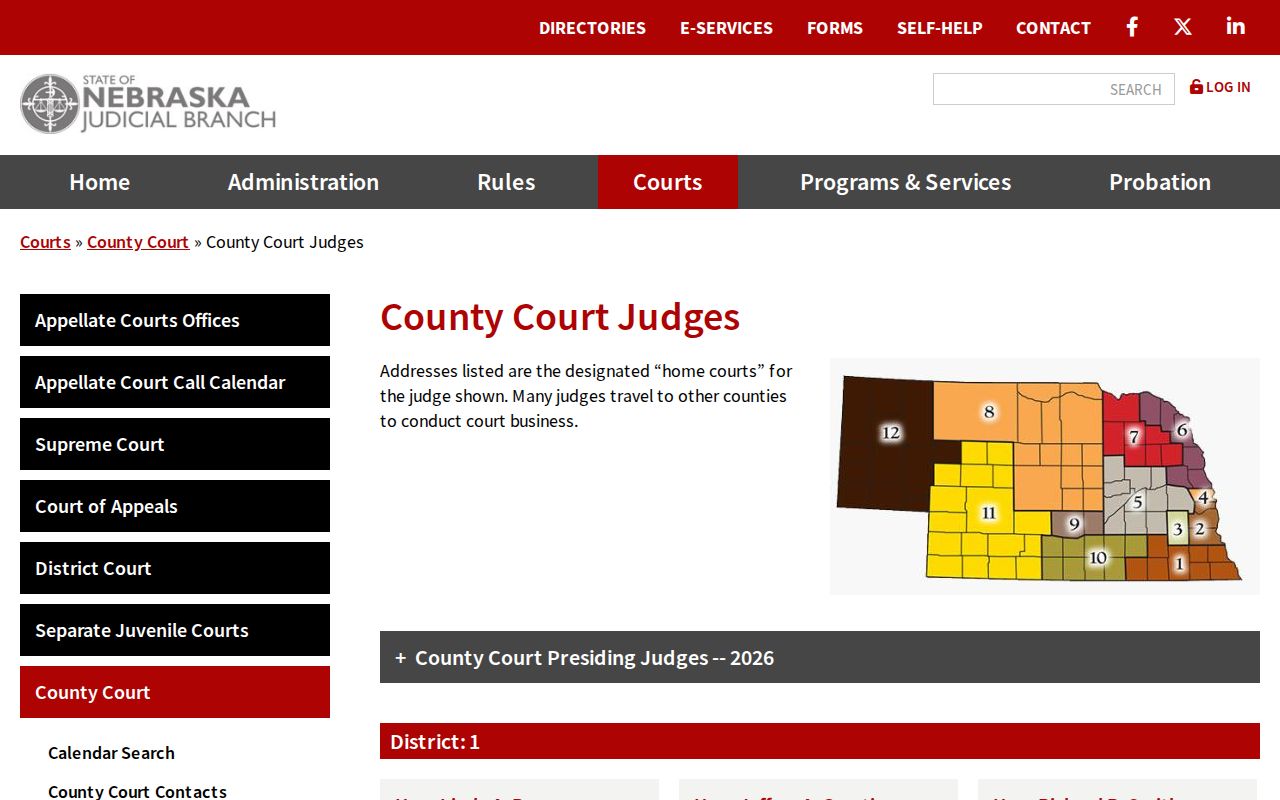
For statewide context on the McCook courthouse route, the County Court judges directory lists the judges who serve it.
Chasing an older McCook court docket? A clerk can tell you whether the paper file was converted, retained, destroyed, sealed, or simply unavailable.
Where McCook Cases End Up
McCook cases don't all end at the same court. County Court handles traffic, misdemeanors, ordinance cases, preliminary felony hearings, small claims, probate, guardianship, adoption, juvenile matters, and many civil cases. Some begin there and stay there. District Court takes the felony trials, larger civil matters, equity, domestic relations, mental-health cases, and County Court appeals. Knowing which lane a case sits in tells you which clerk holds the docket.
Docket flow: McCook city administration › Red Willow County Court › Red Willow District Court
A McCook appeal runs through the Nebraska appellate system, separate from the trial court's register of actions. Federal civil, criminal, bankruptcy, and appeal matters are separate again. For the fuller trial-court picture, the county-level overview on the Red Willow County court docket explains the split without treating a city case as its own municipal system.
McCook Court Docket: When Search Is Empty
An empty McCook search proves very little. JUSTICE can show nothing for several reasons. It might be an entry delay, a spelling or name-match problem, or the wrong court type selected. Restricted access, an older paper file, or a case outside Nebraska's trial courts could also explain it. The calendar carries its own warning. A no-result answer does not necessarily mean no court date exists.
Work the problem in order. First confirm the case number, the year, the court, and the Red Willow County filter. Then ask the right clerk whether the record sits in County Court or District Court. Ask as well whether it predates electronic conversion, and whether access is limited. Sealed, juvenile, adoption, and protected records are not ordinary search gaps.
Public Access to McCook Court Records
Public access to McCook court records follows Nebraska's statewide court rules. It is not a city rule of its own. Article 8 of the Nebraska Supreme Court rules opens the door to searchable case information. That covers party index, case summary, register of actions, available images, calendar information, and judgment summaries. When online search falls short, the courthouse terminal and the clerk are the fallbacks.
State law does not make every McCook file public. Sealed records, juvenile material, adoption records, statutory exceptions, and protected information stay off limits. For an ordinary copy, Form CC 3:29 asks for the court, the county, and the case. It also wants the document or date, your delivery choice, and whether you want certification. A transcript comes from the court reporter, not from the register of actions.
Key Rules:
Nebraska Public Records Act §84-712 establishes examination and copying of public records during ordinary office hours, subject to exceptions and fees.
Nebraska Supreme Court Rule §1-803 requires the same public court information for each member of the public.
Nebraska Supreme Court Rule §1-805 identifies searchable court-information categories and limits.
McCook Court Docket: Case Number First
Start with the case number. It is the strongest public identifier you can hold. That matters in McCook, especially when a name belongs to several people. Pair the number with the court and the county. Then you can tell whether an entry sits in County Court or District Court. A clerk request moves faster too. The number narrows the court, the filing year, the case type, and the trail of documents behind it.
Write down only what identifies the McCook matter: court, county, case number, and case type. Add a filing or status date and the relevant register-of-actions event. Leave personal details out of your request and notes. That means no addresses, birth dates, financial-account information, minors' details, or sealed-document content. A docket entry is a lead, not a conclusion about anyone.